

SUMMARY 2018

The issues identified in the inspections carried out by SIACI in 2018 can be summarised as follows:
| No | ISA reviewed | Area | No of issues identified | Percentage |
| 1 | ISQC, ISA 220 | Internal control system | 11 | 7% |
| 2 | ISA 300, ISA 250 | Planning | 13 | 9% |
| 3 | ISA 500, ISA 520, ISA 530, ISA 501, ISA 505, ISA 540 | Audit evidence, external confirmations | 111 | 74% |
| 4 | ISA 550 | Related parties | 3 | 2% |
| 5 | ISA 260 | Communication with those charged with governance | 4 | 3% |
| 6 | ISA 580 | Completion of the audit | 2 | 1% |
| 7 | ISA 700, ISA 701, ISA 706 | Audit report | 4 | 3% |
| 8 | ISA 570 | Going concern | 1 | 1% |
| TOTAL | 149 | 100% |
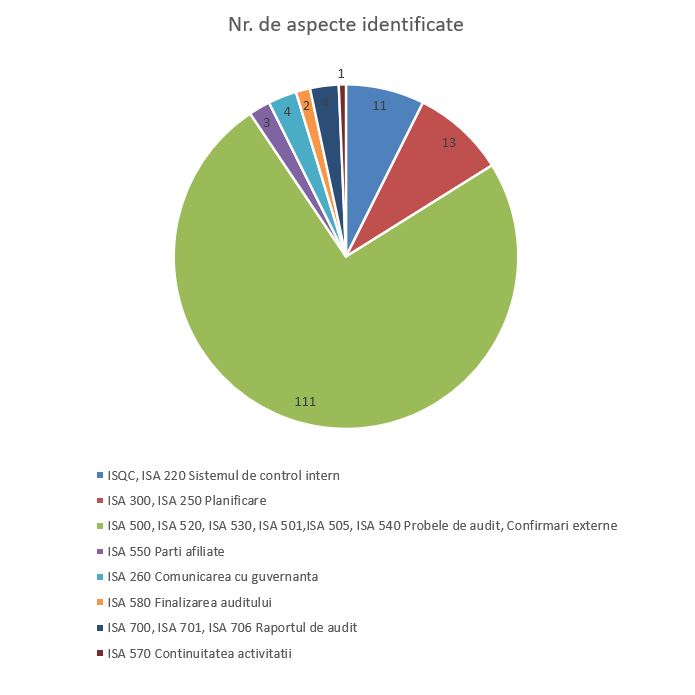 The most frequent issues identified in the audit files inspected in 2018 are as follows:
– Documentation:
In the vast majority of engagements we identified insufficient documentation of the nature and timing of the audit procedures performed, of who performed and who reviewed the audit work, and of the date and extent of the review, such that an experienced auditor with no previous connection with the audit could understand all the essential aspects of the audit engagement.
– Lack of professional scepticism
We identified a deficiency in the application of professional scepticism. For example, audit teams did not adequately challenge management’s estimates regarding the provisions recognised, or the need to recognise them, in order to arrive at the fair value of assets.
– Lack of consistency
There were cases in which we identified a mismatch between the control procedures established in accordance with ISA 220 and their application in the audit files of the audited entities.
– Audit evidence:
In many cases we identified confusion within the audit team between documents obtained from the audited entity and audit evidence. We identified cases in which the auditor did not understand how audit evidence can be considered appropriate and sufficient. The sufficiency and appropriateness of audit evidence are interrelated. Sufficiency is the measure of the quantity of audit evidence. The quantity of audit evidence needed is affected by the auditor’s assessment of the risks of misstatement (the higher the assessed risks, the more audit evidence is likely to be required) and also by the quality of that audit evidence (the higher the quality, the less may be required). Obtaining more audit evidence, however, may not compensate for its poor quality.


