

SUMMARY 2021

1. Inspection activity in 2021
In 2021, ASPAAS carried out inspections of statutory auditors and audit firms performing statutory audit activities, in accordance with Law No 162/2017, as amended and supplemented, and the applicable rules.
1.1 The 2021 inspection plan
In line with the 2021 inspection plan, ASPAAS carried out inspections of statutory auditors and audit firms that performed statutory audit engagements from March to December. In 2021, inspections were carried out by inspection teams made up of SIACI inspectors at the ASPAAS headquarters, without face-to-face meetings with the statutory auditors or audit firm representatives; the documentation for the audit engagements inspected was sent electronically by email. For the 8 inspections carried out in 2021, 3 inspection reports and 4 findings notes were issued and communicated to the statutory auditors and audit firms inspected. One inspection report is currently being finalised and will be communicated to the audit firm shortly. In 2021, 8 inspections were carried out at audit firms and statutory auditors, namely 4 periodic inspections and 4 follow-up inspections, covering the assessment of 10 statutory audit engagements, 8 of them at public-interest entities. The updated 2021 inspection plan approved by the President of ASPAAS comprised 10 inspections, of which 6 periodic and 4 follow-up inspections:
| Total planned | Total completed | % | |
| Periodic inspections | 6 | 4 | 67% |
| Follow-up inspections | 4 | 4 | 100% |
| Total inspections | 10 | 8 | 80% |
| Engagements inspected | 12 | 10 | 83% |
Statutory audit engagements inspected, by type of audited entity:
| Type of audited entity | No of statutory audit engagements inspected |
| Public-interest entities, total, of which: | 8 |
| – Companies whose securities are admitted to trading on a regulated market; | 2 |
| – Credit institutions | 1 |
| – Insurance, insurance-reinsurance and reinsurance undertakings; | 1 |
| – Non-bank financial institutions, as defined by law, entered in the General Register; | 1 |
| – National companies; wholly or majority state-owned companies; autonomous public enterprises; | 3 |
| Entities other than public-interest entities | 2 |
| Total audit files inspected | 10 |
The SIACI inspection teams’ reviews focused on the audit documentation and the professional judgements used for the significant areas of the financial statements and for areas with a medium or high risk of misstatement. A significant number of professional judgements were reviewed, including, where relevant, the measurement of assets carried at market value, the existence and measurement of transactions, cut-off, revenue recognition and the going concern assessment.
1.2 Main findings
The inspection reports drawn up following the 4 periodic inspections carried out in 2021 highlighted approximately 58 findings, for which recommendations were made to the audit firms and statutory auditors inspected. SIACI monitors the remediation by audit firms and statutory auditors of the deficiencies found during periodic inspections. Monitoring of the implementation of the recommendations is carried out through follow-up inspections in accordance with the Inspection Rules. The 4 follow-up inspections carried out in 2021 found that, of the approximately 74 deficiencies identified in the previous periodic inspections, 20 had been remedied, 20 partially remedied and 34 not remedied. The findings of the periodic inspections carried out by SIACI in 2021 are summarised as follows:
| No | ISA reviewed | Area | No of issues identified | Percentage |
| 1 | ISQC, ISA 220 | Internal control system | 19 | 33% |
| 2 | ISA 300, ISA 250, ISA 315, ISA 230, ISA 330, ISA 530 | Planning | 7 | 12% |
| 3 | ISA 500, ISA 520, ISA 530, ISA 501, ISA 505, ISA 540, ISA 230 | Audit evidence, external confirmations, audit documentation | 23 | 40% |
| 5 | ISA 260 | Communication with those charged with governance | 1 | 2% |
| 8 | ISA 570, ISA 560 | Going concern and subsequent events | 3 | 5% |
| 9 | ISA 210 | Agreeing the terms of the engagement | 2 | 3% |
| 10 | Other specific requirements of Law No 162/2017 and Regulation (EU) No 537/2014 | Other matters | 3 | 5% |
| TOTAL | 58 | 100% |
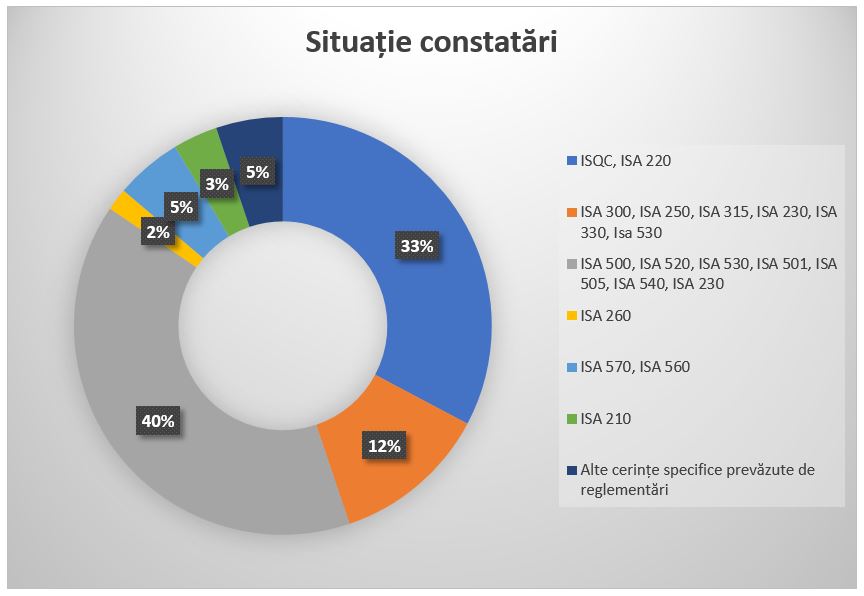
The main findings of the inspections carried out in 2021 relate to the following:
a) Review of the internal control system
In general, the statutory auditors and audit firms inspected complied with the obligation to have firm-level and engagement-level quality control procedures (ISQC 1 and ISA 220). The inspection teams’ findings on this matter relate rather to their content and actual application in statutory audit work and to the documentation of the tests performed at engagement level in the audit files. Cases were identified in which the procedures were general in content and not tailored to the needs and size of the statutory auditor’s/audit firm’s practice or to the specific activity of the audited entities. One of the significant issues found in the inspections of audit firms/statutory auditors is the absence of an engagement quality control review partner and, consequently, the absence of an engagement quality control review or inadequate documentation of this work.
b) Documentation:
Documenting audit evidence is important in statutory audit engagements because it is the main means by which the statutory auditor/audit firm can demonstrate its sufficiency and appropriateness. The audit file must contain sufficient appropriate audit evidence to support the conclusions of the statutory auditor/audit firm on which the audit opinion is based. In the inspections carried out, the inspectors found a deficiency in the documentation of audit engagements which, in some cases, does not meet the requirement in paragraph 8 of ISA 230 to enable an experienced auditor, having no previous connection with the audit, to understand the nature, timing and extent of the audit procedures performed, the results of those procedures and the audit evidence obtained, and the significant matters arising during the audit, the conclusions reached thereon and the significant professional judgements made in reaching those conclusions.
c) Lack of consistency in the application of audit procedures
The inspections repeatedly found that audit procedures existed in accordance with ISA 220 but had no direct link with the audit file inspected or with the specific circumstances of the audit firm or statutory auditor inspected. The procedure must be tailored to the audit practice and should therefore be improved whenever necessary, in light of practical issues encountered, experience gained and changes in professional regulations. The inspectors emphasise these aspects and draw attention to the importance of applying tailored procedures.
d) Audit evidence:
In some cases, deficiencies were identified in the assessment by the statutory auditor or audit firm inspected of the sufficiency and appropriateness of audit evidence. The sufficiency and appropriateness of audit evidence are interrelated. Sufficiency is the measure of the quantity of audit evidence. The quantity of audit evidence needed is affected by the auditor’s assessment of the risks of misstatement (the higher the assessed risks, the more audit evidence is likely to be required) and also by the quality of that audit evidence (the higher the quality, the less may be required). However, obtaining more audit evidence may not compensate for its poor quality.
e) Audit assertions
It is important to note that, in inspection work, the inspection teams’ professional judgement on how the statutory auditor/audit firm ensured that sufficient appropriate audit evidence is documented on file is based on the main assertions described in ISA 315 (Revised), depending on the sections inspected. A significant number of findings in the inspection reports concern how audit evidence is documented in order to consider the different types of potential misstatements; there are cases in which the statutory auditor/audit firm inspected, either at the planning stage or during the audit engagement, did not ensure that all relevant assertions, as described in paragraph A129 of ISA 315 (Revised), were addressed.
f) Identifying and assessing the risks of material misstatement:
In the inspections, the issues found in risk identification and assessment relate to deficiencies in the judgements on the size of misstatements considered material, or a lack of evidence of how the nature, timing and extent of risk assessment procedures were determined, and of how the nature, timing and extent of further audit procedures following the risk identification stage were determined. Procedures for understanding the audited entity are of great importance in determining significant risks. The auditor must document the conclusions on these risks, why they are considered significant and how the tests needed to examine them are planned, including the determination of key audit matters (KAM) as set out in ISA 701 (where KAMs are identified, the auditor must explain in the audit report how they were addressed and why they were considered key matters, and these matters must be properly documented in the audit file).
g) Analytical procedures
The inspections found deficiencies in audit evidence at the completion stage of statutory audit engagements: in some cases, the audit documentation for this stage does not include the analytical procedures needed to form an overall conclusion as to whether the financial statements are consistent with the statutory auditor’s/audit firm’s understanding of the entity, as required by paragraph 6 of ISA 520.
1.3 Conclusions drawn from the inspections carried out by SIACI in 2021:
Regulation (EU) No 537/2014 established the Committee of European Auditing Oversight Bodies (CEAOB), whose main aim is to improve the quality of statutory audit at public-interest entities in Europe and, in turn, to increase stakeholder confidence in statutory audit and in the auditor’s report. To this end, the CEAOB established a common European approach for all its members, from which ASPAAS also benefited, in that its inspection procedure was harmonised with the European inspection procedure. A transition period was needed for statutory auditors and audit firms in Romania to adapt to the new requirements for statutory audit work. In 2021, significantly fewer findings were made than in previous years, which indicates an improvement in audit quality across the audit market, especially among statutory auditors and small audit firms, where the need to adapt to the new requirements was greater. As the table below shows, compared with the previous period, in 2021 all statutory audit engagements inspected were either at an appropriate level of compliance with professional standards, with minor and/or optional recommendations for improving audit practice, or at an acceptable level of audit practice with mandatory recommendations for improvement within the deadlines set by the inspection team, whereas in 2020 only 55% of the statutory audit engagements inspected were at this level, 71% in 2019 and 17% in 2018.
| Conclusions of the inspection report on the assessment of the audit engagements selected in periodic inspections, made in accordance with Article 16(4)(a)–(b) | 2021 | 2020 | 2019 | 2018 |
| a) are at an appropriate level of compliance with professional standards, with minor and/or optional recommendations for improving audit practice; or b) are at an acceptable level of audit practice, with mandatory recommendations for improvement within the deadlines set by the inspection team; | 100% | 55% | 71% | 17% |
| c) require significant improvements within the deadlines set by the inspection team. | 0% | 45% | 29% | 83% |
| Inspection reports referred to the ASPAAS Disciplinary Committee, total: | 2 | 5 | 0 | 1 |
| – of which relating to periodic inspections: | 0 | 5 | 0 | 1 |
| – of which relating to follow-up inspections: | 2 | 0 | 0 | 0 |
2. PIE compliance with the requirements of Article 65 of Law No 162/2017 – inspection findings.
Article 65(1) of Law No 162/2017 provides that “Public-interest entities must have an audit committee, in accordance with the law.”, while paragraph (7) of Law No 162/2017 provides that “Entities whose annual financial statements are subject by law to statutory audit must organise and ensure the performance of internal audit, in accordance with the legal framework”. Inspection findings on whether PIEs met the obligation to have an audit committee:
| Total statutory audit engagements at PIEs inspected | No of PIEs that met the obligation to have an audit committee | % |
| 8 | 6 | 75% |
(the inspections concern audits of financial statements as at 31.12.2019)
As a general trend, the SIACI inspections found that statutory auditors/audit firms do not use controls over internal audit tests in their procedures, even though internal audit reports and the audited entity’s internal audit procedures are an important source for identifying the entity’s risks and can, in many cases, lead to the identification of material misstatements that might otherwise remain undetected by other audit procedures (for example, tests of details). SIACI set as an objective ensuring that audited entities comply with the provisions of Law No 162/2017 on the obligation to organise internal audit and, where applicable, to establish an audit committee, and encouraging statutory auditors and audit firms to use the work of internal auditors, internal audit being a key means and tool of an entity’s management, with the role of monitoring the efficiency and effectiveness of its activity. Internal audit is becoming a key governance tool in its strategic role of monitoring the entity’s activity. The audit committee and the board of directors must ensure, including through a periodic independent external assessment, that the internal audit function is appropriately positioned within the organisation and has the human resources and processes needed to meet the entity’s strategic objectives and initiatives.
3. Contravention sanctions imposed on statutory auditors and audit firms:
- no contravention sanctions were imposed as a result of inspection activity;
- one contravention sanction was imposed as a result of investigations carried out by SIACI inspectors.


