

SUMMARY 2019

The issues identified in the inspections carried out by SIACI in 2019 can be summarised as follows:
| No | ISA reviewed | Area | No of issues identified | Percentage |
| 1 | ISQC, ISA 220 | Internal control system | 170 | 36% |
| 2 | ISA 300, ISA 250, ISA 315 | Planning | 59 | 13% |
| 3 | ISA 500, ISA 520, ISA 530, ISA 501, ISA 505, ISA 540 | Audit evidence, external confirmations | 167 | 35% |
| 4 | ISA 550 | Related parties | 1 | 0% |
| 5 | ISA 260 | Communication with those charged with governance | 12 | 3% |
| 6 | ISA 580 | Written representations | 4 | 1% |
| 7 | ISA 700, ISA 701, ISA 706 | Audit report | 31 | 7% |
| 8 | ISA 570 | Going concern | 3 | 1% |
| 9 | ISA 210 | Agreeing the terms of the engagement | 11 | 2% |
| 10 | Other matters | 13 | 3% | |
| TOTAL | 471 | 100% |
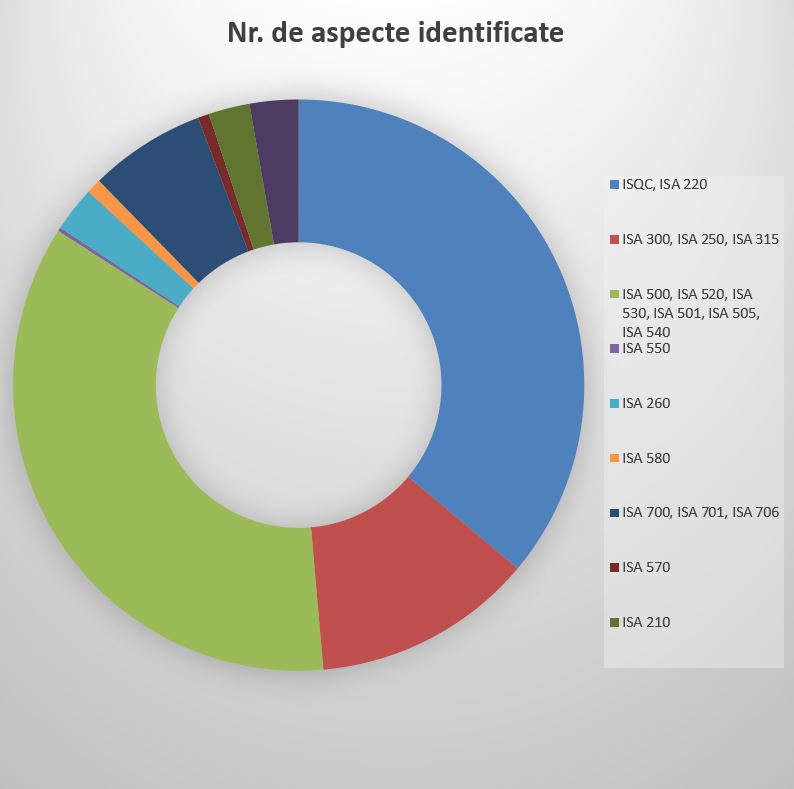
Issues frequently identified in the audit files inspected in 2019 are as follows:
a) Review of ISQC 1 and ISA 220
In general, the statutory auditors/audit firms inspected complied with the obligation to have firm-level and engagement-level quality control procedures (ISQC 1 and ISA 220); our recommendations on this matter related more to their actual application in statutory audit work and to the documentation of the tests performed in the audit files. We identified certain cases in which quality procedures were drafted in general terms and not tailored to the needs and size of the auditor’s practice or to the industry/activity of the audited entities. One of the significant issues found by the inspection team was the absence of an engagement quality control reviewer or inadequate documentation of the reviewer’s work.
b) Documentation:
The main issues identified in this respect concerned insufficient documentation that does not meet the requirement in paragraph 8 of ISA 230 to enable an experienced auditor, having no previous connection with the audit, to understand the nature, timing and extent of the audit procedures performed, the results of those procedures and the audit evidence obtained, and the significant matters arising during the audit, the conclusions reached thereon and the significant professional judgements made in reaching those conclusions.
c) Lack of professional scepticism
A deficiency was identified in the application of professional scepticism. For example, the inspection teams found certain cases in which the evidence in the audit files inspected was based exclusively on management representations, with no evidence testing the statements made by the representatives of the audited entities.
d) Lack of consistency in the application of audit evidence
There were cases in which a mismatch was identified between the control procedures established in accordance with ISA 220 and their application in the performance of audit engagements. In addition, for the vast majority of the auditors inspected, we identified a mismatch between audit planning and the subsequent evidence. We emphasise the importance of planning for any audit file. Through this section, the auditor can understand the audit approach, the time needed and the other resources required. We also emphasise the importance of identifying audit risks and documenting how they are addressed by audit procedures.
e) Audit evidence:
There are cases in which the statutory auditor/audit firm did not understand how audit evidence can be considered appropriate and sufficient. The sufficiency and appropriateness of audit evidence are interrelated. Sufficiency is the measure of the quantity of audit evidence. The quantity of audit evidence needed is affected by the auditor’s assessment of the risks of misstatement (the higher the assessed risks, the more audit evidence is likely to be required) and also by the quality of that audit evidence (the higher the quality, the less may be required). Obtaining more audit evidence, however, may not compensate for its poor quality.
f) Audit assertions
In some cases, the approach to the audited sections needed to be improved by enhancing audit procedures so that they use all assertions to consider the different types of potential misstatements that may occur, as described in ISA 315, paragraph A124.
j) Identifying and assessing the risks of material misstatement:
In the inspections carried out, the issues found regarding risk identification and assessment relate to deficiencies in the judgements on the size of misstatements considered material, or a lack of evidence of how the nature, timing and extent of risk assessment procedures were determined, and of how the nature, timing and extent of further audit procedures following the risk identification stage were determined.
k) Analytical procedures
The need was identified to design and perform analytical procedures near the end of the audit to assist the auditor in forming an overall conclusion as to whether the financial statements are consistent with the auditor’s understanding of the entity, as required by paragraph 6 of ISA 520.
l) Completion stage of the audit
In some cases, deficient application of ISA 330, paragraph 20, was identified regarding the auditor’s substantive procedures relating to the financial statement closing process.


